Treading Lightly
Treading Lightly

Moving out

First off, for my own enjoyment: I am on summer break! It feels so good to say that. But before being able to be officially on summer vacation, every college student has to move out. I had a crazy finals week with work, an interview (where I got a really cool internship with the Sierra Club, more info on that later : ) ), and packing. I don’t know how, but I managed to do it all.

Before I had started packing I decided I had too much stuff and I needed to get rid of some of it. I have to admit, however, that despite my best intentions, I only donated 2 long-sleeve T-shirts. When I was packing I asked myself if I had used it recently and if I really needed the item. It seems to make sense though that all my answers were “yes” because the room really is so small that no extra, unused things can easily fit.

What really surprised me was how much stuff other people threw out! There were piles of e-waste at the drop off locations. What really bothered me is that there is no way in one building the students broke 2 toasters, 4 coffee makers, 2 small vacuums, a printer, countless ink cartridges, and other items. Although the cartridges were most definitely empty, there are locations (like Costco) that will refill them for reuse. This was all the stuff that I saw at 1 location on one day early in the week, and I have a strong feeling most of it could be reused, sold, donated, or just passed on to someone else. What do people think recycling is? If they knew it was going to be shredded would they still have put it there? (Check back tomorrow for my experience at an e-waste recycling facility!)

They also had huge dumpsters around campus near all of the dorms. The one outside of mine (that did serve about 3 large dorms. I would say maybe 300 students) was overflowing by the time I left on the last day.

This picture was taken two days before most students had moved out and it was already halfway full. It was so big that they had to put stairs in front of it so you could get your trash into it. What I really do not understand is what students were throwing away. We had places to donate books, furniture, rugs, and other items. So what filled up this dumpster and could it have been avoidable?

During move out (and the days before while I was packing) I threw out 2 ink cartridges wrappers, 4 paper towels (I hate them, but there was no way I was going to clean out where our trash had been with a towel) and a plastic bag… So where did all of this trash come from? Is this the waste we normally create during the average week and it was just concentrated in one place making it more noticeable? It’s frightening to consider.

Plastic trash bag nightmare

I am just finishing up a project for SCU’s library where with a team of three other people we proved that removing individual trash cans from every study room in our library (a total of about 40 rooms) reduced the total amount of waste created as well as left the rooms just as clean. I know you are thinking right now, “who cares?” but this is actually a big deal.

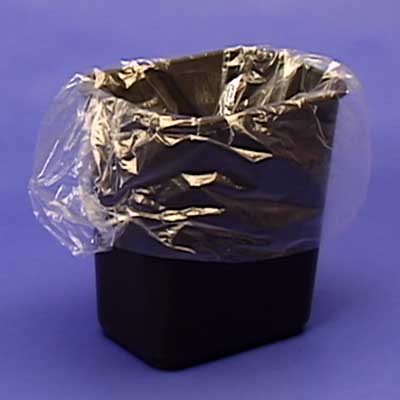
Have you ever considered how much of your trash is made up of the bag alone? On campus the custodians have to empty the trash cans daily, even if there is just a single item in the bag. This meant that we were having nearly empty bags being removed from every single one of the rooms every day.

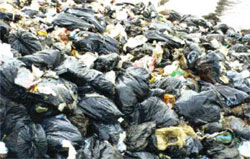
Image courtesy of GD wholesale
So what? Trash bags are meant to be thrown out, what difference does it make? It makes a huge difference. Even though companies sell us these bags to contain our garbage perfectly until we get them to the curb, they give little consideration to what happens after they leave your curbside can. Did you know that most trash bags are made of plastic, a material that can take millions of years to break down?
Image courtesy of reusable shopping bags
Even then plastic is not an organic material that can be ingested and broken down by microorganisms or other living things. Instead they are broken down by the sun and other physical forces that really only break them up into smaller and smaller particles. In other words, your plastic trash bag will outlive you by millions of years and the particles of every bag you have ever thrown out will never disappear.
Starting to feel bad about every single plastic bag you have ever sent to the dump? Don’t worry, there are better options that will break down naturally and quickly.
Look for compostable or biodegradable bags at your grocery store, specialty food stores, local hardware store, or online. The options are abundant and the prices, though not exactly as cheap as their polluting counter-parts, are still low and affordable on any budget.

Also, don’t forget to compost all food items so you can take out the trash less often, save yourself money, and send fewer bags to the landfill. Can’t compost where you live and there are no facilities near you that will take compostable items? You can still collect food scraps in a container under the sink and take those out separately every day to decrease bags used and the stench when you don’t take out the trash enough.

Sun protection

Today was my first day of work for the summer. Unfortunately it was cloudy and cold so only 2 of my 20 something coworkers applied any form of sun protection. Apparently they did not know that UVA and UVB pass through the clouds. I guess they will figure it tomorrow when they have a painful sunburn.
Another reason many people forget to put on sunscreen is because their skin is cool. Beware that just because there is a breeze or you are in cool water does not mean that you are not getting burned. Don’t forget to grab your shirt and hat before hitting the beach or the pool this summer!
Although many of the lifeguards failed their sun safety today, a bunch of little kids came fully prepared.
Image courtesy of People
I wish I could pull off a hat and shorts like that…

USDA unveils its “My Plate” and tears down the pyramid

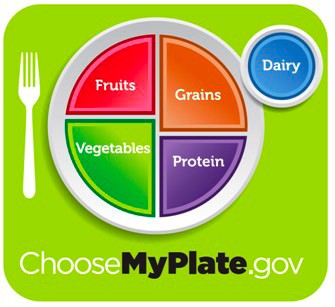
As part of Michelle Obama’s strive to end obesity and help our nation get back on track with our diets and health, she partnered with the Department of Agriculture to create an alternative to the food pyramid, “My Plate.” My plate is an easier way for Americans to understand what they should be eating at every meal with a plate clearly divided into the important food groups: fruits, grains, vegetables, protein, and dairy.

Image courtesy of DesMoinesRegsiter
As thankful that I am that Michelle Obama is trying to decrease the rates of obesity and other diet related health problems in the United States, I am afraid that this new graphic will not increase diet awareness any more than the convoluted pyramid did. Although this clearly shows the necessary food groups for each meal, it neglects the fact that protein, dairy, and grains are often interchangeable. Do you really need a grain that includes protein, dairy (which also has protein), and a meat or meat alternative? No.
The My Plate also does not encourage a sustainable diet. Instead of just listing protein, which would have included dairy, the My Plate has a separate section for dairy. It also appears to be where a glass should go insisting that people drink milk, which is incredibly carbon intensive and typically comes from factory farms. The My Plate also does not give a clear understanding of what protein is, which will most likely lead many Americans to believe that the meat they eat with every meal is following the guidelines.
Am I nitpicking? Perhaps, but I feel like this info-graphic, although better than the pyramid, will not change the basic problems with many American’s diets, including too much meat and dairy with each meal.
On a more positive and supportive note, the USDA released a few tips with the new graphic, which will hopefully make a positive impact on our waistlines:
– Enjoy your food, but eat less
– Avoid oversized portions
– Make half of your plate fruits and vegetables
– Switch to low-fat or fat-free milk
– Compare sodium in foods like soup, bread, and frozen meals – and choose the foods with the lower numbers
– Drink water instead of sugary drinks
Want to make Your Plate more sustainable? Ditch the dairy and meat and instead choose whole grains and other foods that are excellent sources of protein (like quinoa, lentils, oatmeal, brown rice, some whole wheat pasta, beans, and many others). Eat locally grown food and stop eating processed foods (if it comes in a package, its most likely processed. Drink tap water instead of bottled water, juices, sodas, alcohol, or other beverages.

30 day vegetarian challenge

This morning I found a video on GOOD’s 30 day vegetarian challenge and it got me thinking. I have been a vegetarian for about 5 years now, and maybe I should pledge to do something more for a month. Check out their video and see if it can inspire you to create a change in your next 30 days (or 27 : ) ) no matter how small.

I have recently started reading GOOD which is an interesting online format that “is the integrated media platform for people who want to live well and do good. We are a company and community for the people, business, and NGOs moving the world forward.” This morning I found a video on their 30 day vegetarian challenge.

The GOOD 30-Day Challenge: Go Vegetarian from GOOD.is on Vimeo.

What will you pledge for the rest of June? Comment below or let your world know through a Facebook status update what the rest of your June will look like.

Are there toxic waste sites near your home?

Today I had my last class in my environmental communication class, and to cap off our quarter together our professor took us on a walking tour of a few toxic waste sites near Santa Clara University (including superfund sites). The Silicon Valley has more superfund sites per square mile than any other place in the United States, so it should not have been surprising just how many were close to SCU.

Image courtesy of wikicommons
Within an hour and half we were able to see three toxic sites. We would have made it to all 4 that were planned, but some people forgot we were doing the walking tour today and were falling behind in their inappropriate shoes (read flip flops and heals). The 4th site sits right under our noses and we see it every day. It’s across the street from campus near a popular grocery store. From the main part of campus it is clearly visible.
This is a picture of the site looking out from campus. It’s the fenced-in triangle in the middle of the screen behind the white metal box.
This image is looking toward campus and you can see the largest dorm, Swig Hall, standing out in the background (the building under the lamp post). It’s actually a really large site and SCU students are itching to build a garden or something else on it. (Sorry for the poor quality google maps screen shots.)

Can you guess what it was? It was an old gas station and when it went out of business, the owners decided it was too expensive to take the underground tanks out. The tanks inevitably leaked, and until they are removed and the soil around it is cleared, the lot will remain fenced off and completely barren and unusable.

Do you know if you are living next to a toxic waste site? If you are in California you can check out Envirostor. If you are anywhere else in the U.S. the EPA also has a listing of superfund sites. What you find might shock you.

Cellphone radiation

Although this is not necessarily linked to sustainability, it is important for human health. Have you ever thought about how often you talk on a cell phone? Does it charge on your bed or under your pillow? Do you keep it in your pocket at all waking hours? I am certainly guilty of more than one of these, but increased concern of radiation from cell phones is making me reconsider my behavior.

Do we need one of these to talk on our phones?

Photo courtesy of SENSOREE
Photo courtesy of Gerry Balbido
I woke up this morning to a less than cheerful article in the New York Times “Cellphone Radiation May Cause Cancer Advisory Panel Says”:

“A World Health Organization panel has concluded that cellphones are ‘possibly carcinogenic,’ putting the popular devices in the same category as certain dry cleaning chemicals and pesticides, as a potential threat to human health.

“The finding, from the agency’s International Agency for Research on Cancer, adds to concerns among a small but growing group of experts about the health effects of low levels of radiation emitted by cellphones. The panel, which consisted of 31 scientists from 14 countries, was led by Dr. Jonathan M. Samet, a physician and epidemiologist at the University of Southern California and a member of President Obama’s National Cancer Advisory Board.

“The group didn’t conduct any new research but reviewed numerous existing studies that focused on the health effects of radio frequency magnetic fields, which are emitted by cellphones. During a news conference, Dr. Samet said the panel’s decision to classify cellphones as ‘possibly carcinogenic’ was based largely on epidemiological data showing an increased risk among heavy cellphone users of a rare type of brain tumor called a glioma.”

What can we do to protect ourselves from harmful radiation? Talk on your phone less, and when you do, use speaker phone or an earpiece. Do not keep your phone in your pocket and definitely do not sleep with your phone close to your pillow or your bed.

To see how your phone ranks check out EWG’s list and their advice on things you can do to decrease your exposure. CNET also has a list and some suggestions.

What do you know about e-waste?

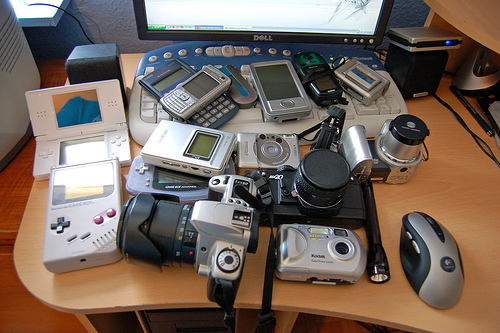
When I walk around campus lately everyone has their cellphone glued to their hand, myself included sometimes. It’s incredible to think about how many electronic objects reside on our small campus alone —  cellphones, thousands of computers, coffee machines, hair dryers, and on and on. Have you ever tried to count how many electronic products you own? How many you use in a day? It’s exhausting.

Photo courtesy of Super Scholar
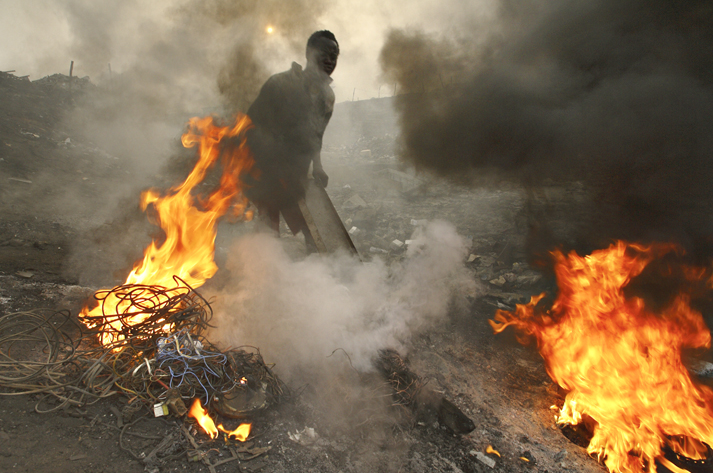
And yet few students seem to know much about what happens to their products when they are done. I have been interviewing students about e-waste for a documentary for a class, and their responses have been interesting. Some students have never considered what happens with their electronics and freely stated they threw them away. Others were incredibly knowledgable and talked about how much of our e-waste is exported to third world countries.
Images courtesy of National Geographic

According to Planet Green,

“The nation dumps between 300 and 400 million electronic items per year, yet less than 20% of that e-waste is recycled properly. About 50 million cell phones are replaced worldwide a month, yet only 10% are recycled.”

What shocked me the the most were the students who said the had never heard of e-waste and had no clue what I was talking about. I guess I have always assumed that everyone in Silicon Valley and especially students at SCU have at least a basic understanding of it.

My friend and student at SCU, Lauren D., had as great insight as to why students do not know much about e-waste.

“I think Santa Clara is really good about the environment and they are really conscious about what everything is doing, but I have to say that I think e-waste is one of those problems that we don’t necessarily pay enough attention to anywhere. It’s one of those topics that not as many people know about. People aren’t as educated [about e-waste]… I think at Santa Clara we need to put more attention on it.”

I have a feeling that it’s not just students at SCU that have never been educated on e-waste before. So spread the word and let everyone know where their cellphone goes and encourage your friends to not rush out to buy the next iPhone when their cellphone still works just fine. Share what you know about e-waste to make a difference.