Treading Lightly
Treading Lightly

Incredible homemade strawberry jam

I spent the weekend feeling more like a 1950s housewife than a 21-year-old college student home for the summer. I have been testing Pinterest cleaners, and today I broke out the old jars and made some homemade strawberry jam.

The strawberries from our local farmers market had been incredible, and I decided it would be great to make jam out of them like my mom used to do with my brother and I when we were younger. I remembered the incredible smell of sweet strawberries and licking the sticky syrup off my fingers when we were all done. It turns out making jam is a lot more work than I remembered, but it was absolutely worth it. I can’t wait to make toast in the morning and then drizzle some of the jam over some soy ice cream after dinner. Yum.

Ingredients:
16 cups cleaned, hulled, halved (or cut down more if larger) strawberries
6 cups granulated organic sugar (if sour and unripe, if ripe and sweet, use 4 cups or less)
8 tablespoons powdered fruit pectin
1/2 cup organic lemon juice
Recipe:
From Care2
1. Prepare your strawberries (also, don’t forget to wear dark colors or an apron throughout the entire process. Making jam is messy and will easily stain all clothing and towels you use.)
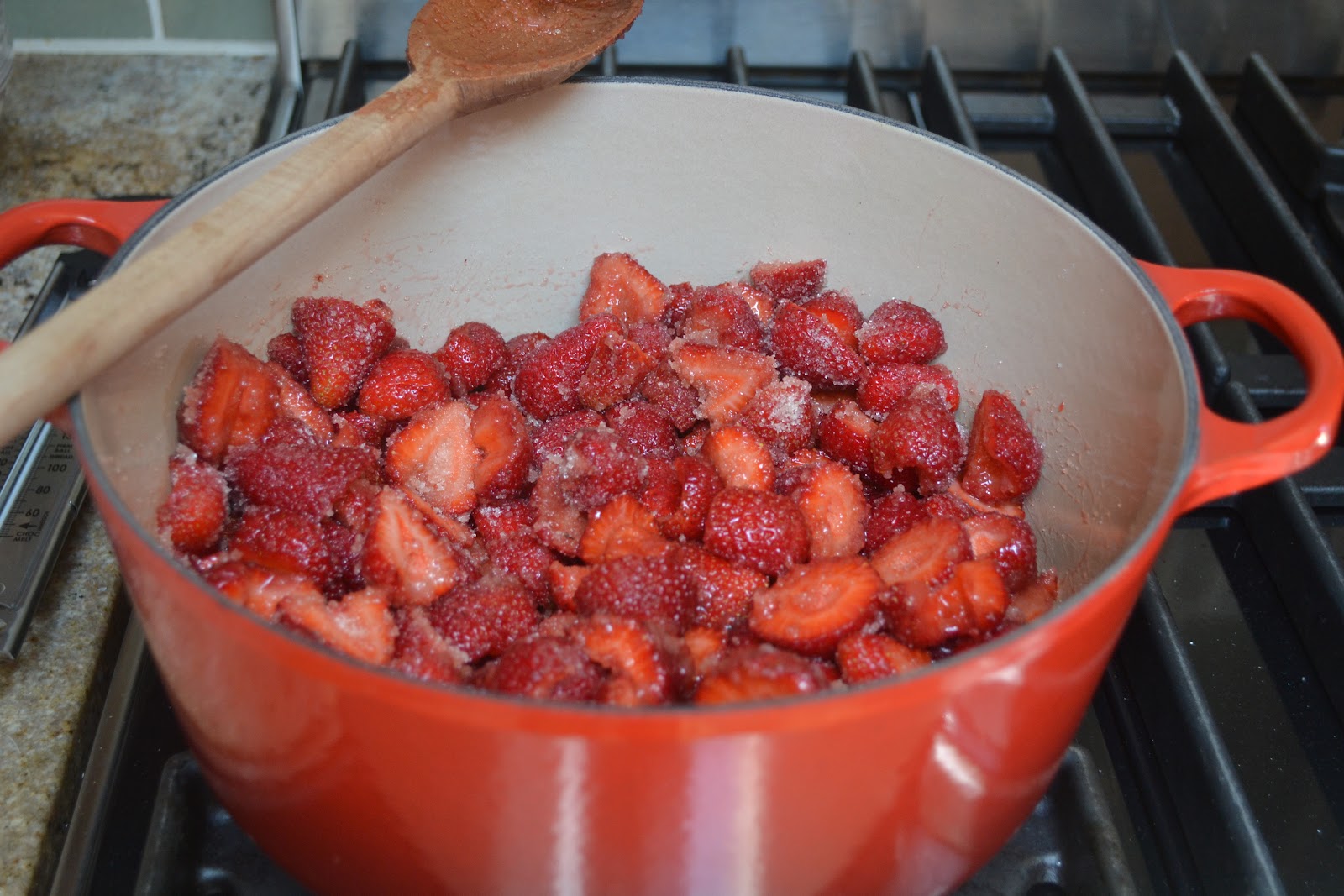
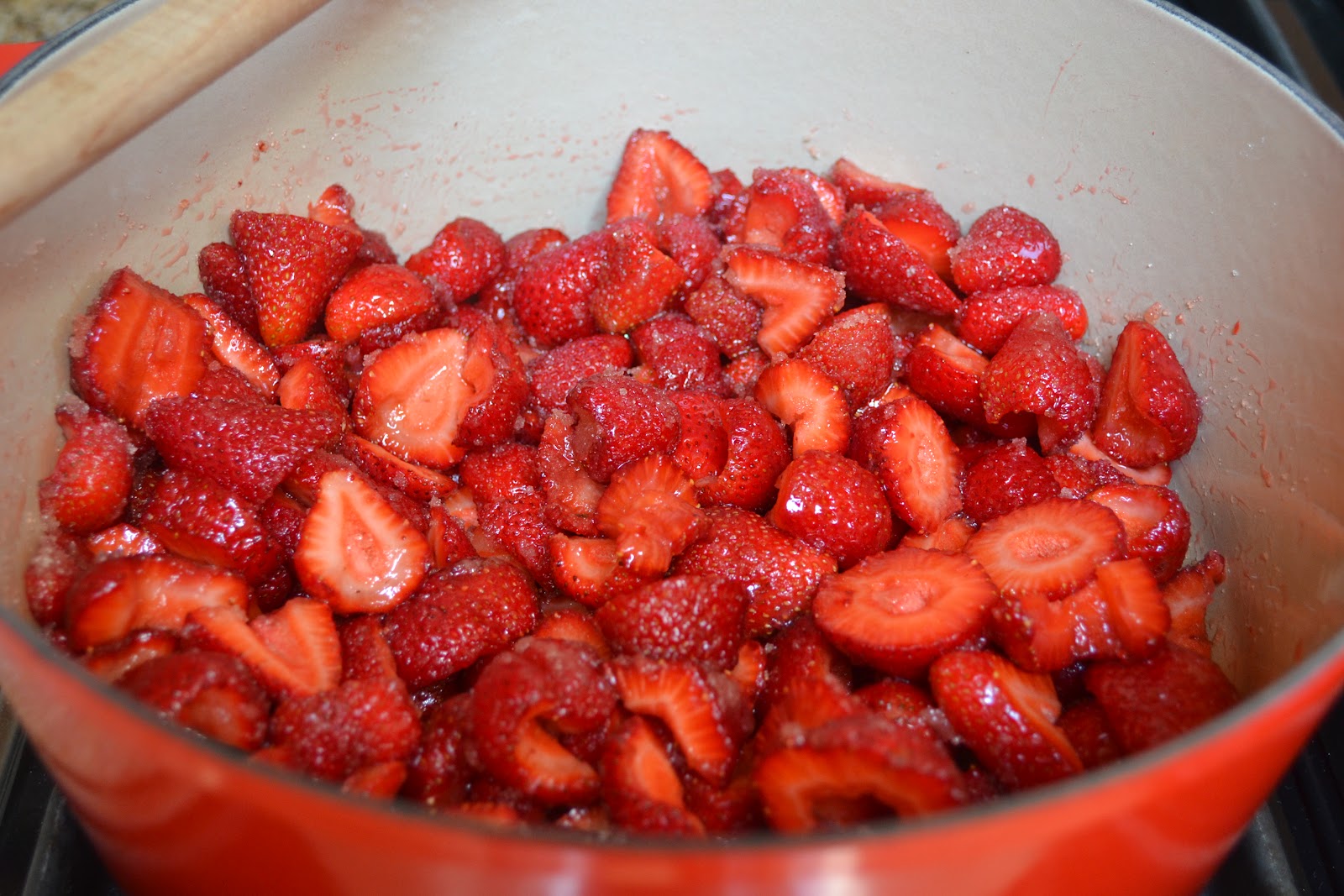
2. Combine the strawberries and 2 cups of sugar in the pot you will cook them in or in a large container that can store in the fridge. Ideally, let the mixture sit for 15 to 30 minutes and then place in the refrigerator overnight. The sugar will pull the liquid out of the berries  and help them to start breaking down (the process is called maceration). I didn’t have time for this so I let them sit for for more than hour.
Once the sugar has completely disappeared and there is juice in bottom of the pot, the berries have broken down enough to start making jam. The longer they can soak in the sugar, the better.
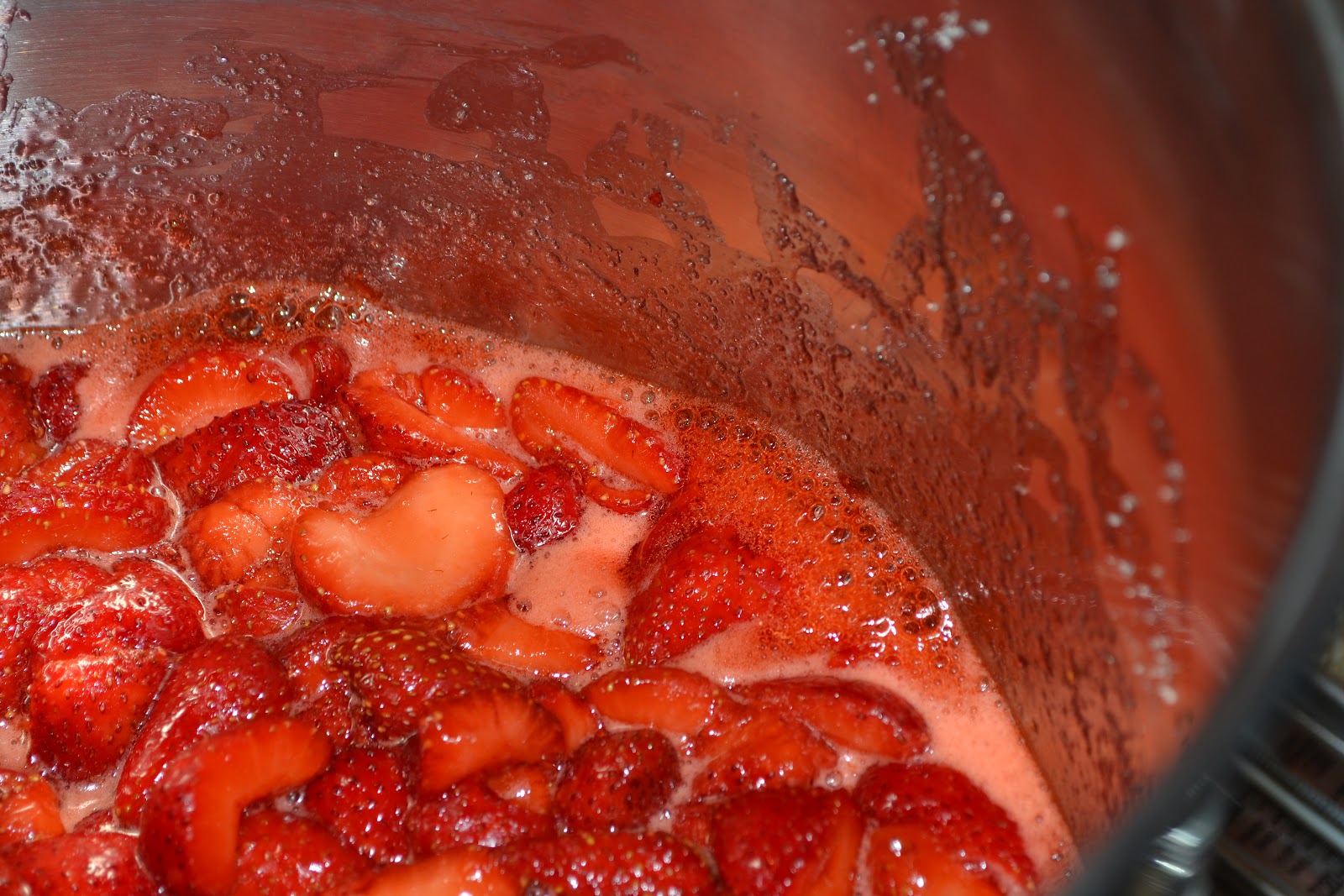
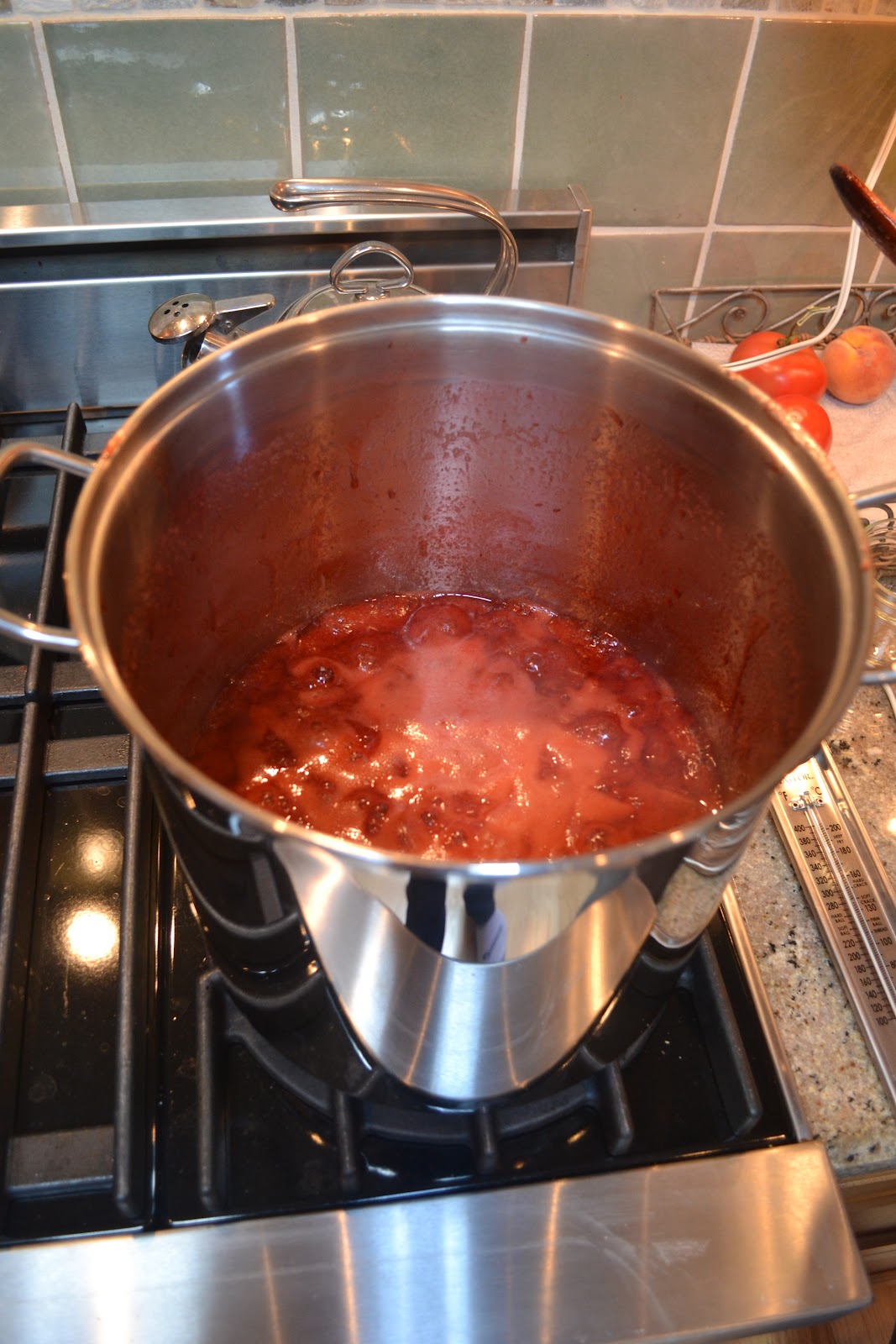
Sixteen cups is a lot of strawberries (an entire flat worth), so when you are ready to start cooking the jam, be sure you use a pot with PLENTY of room. I originally thought this pot was ginormous and WAY too big for my jam, but I almost boiled over it (you can see how much this jam foams and grows in later pictures). Trust me on this one, go big.
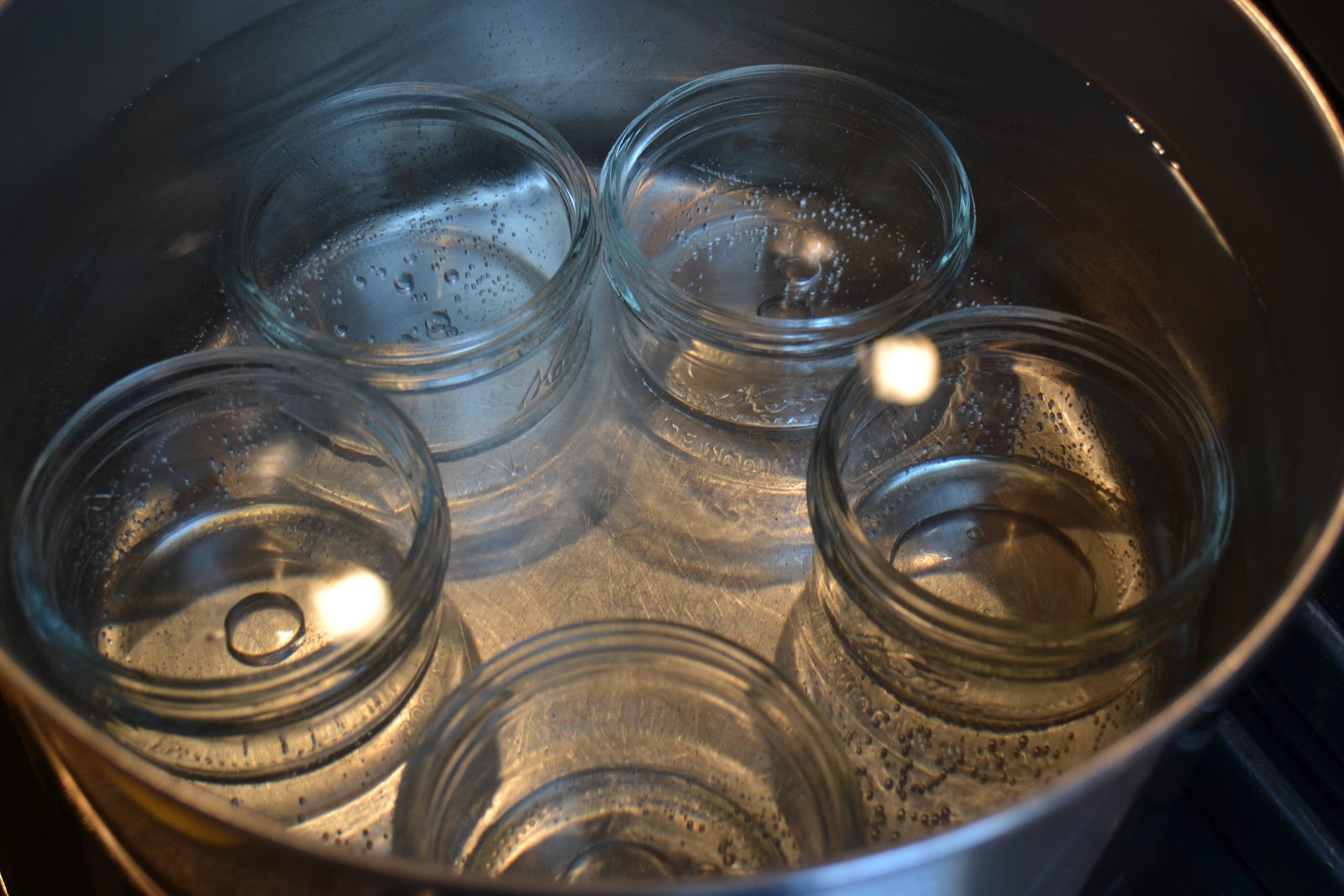
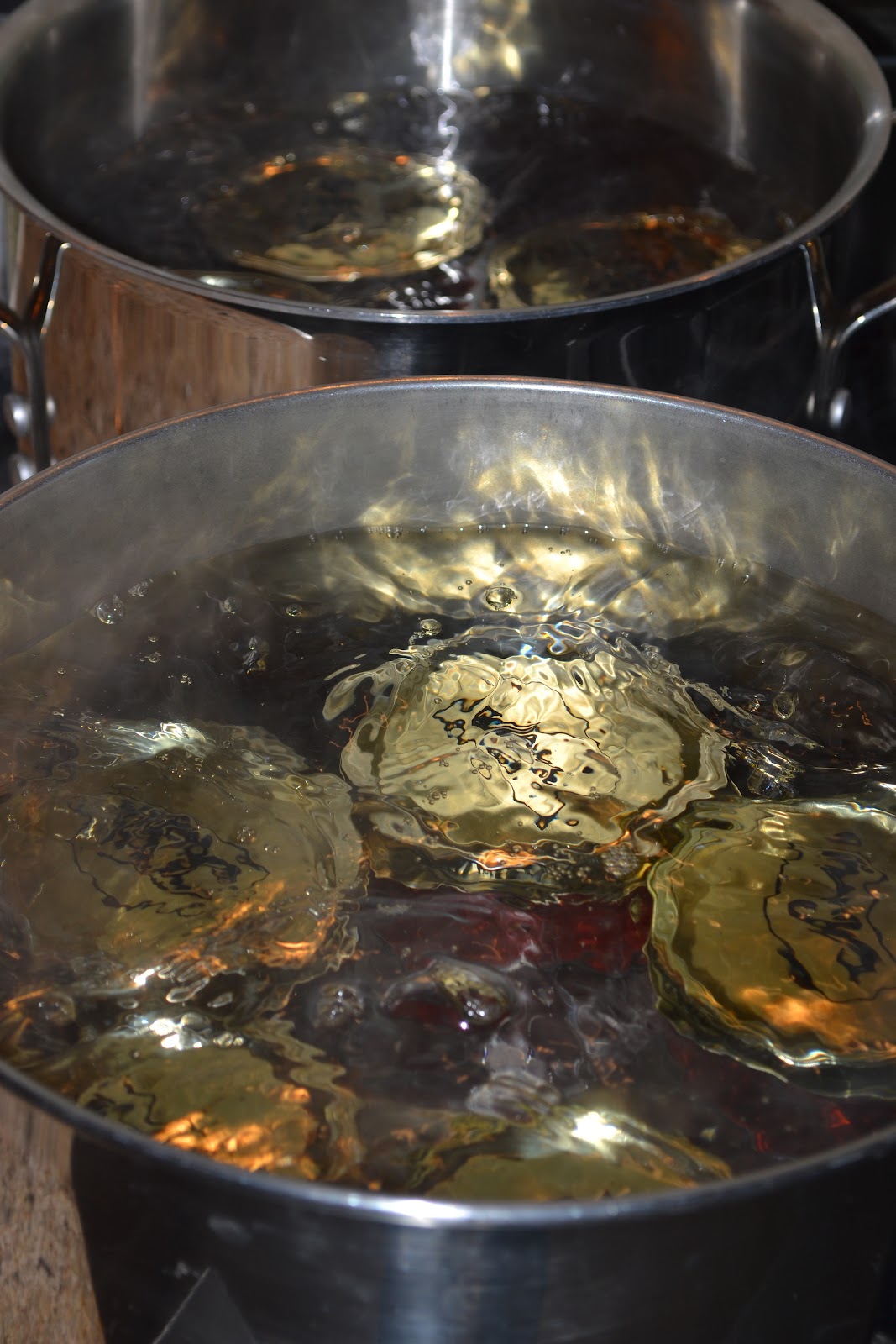
3. When you are ready to start cooking the jam, place jars into a large pot and bring to a boil. I followed these instructions for how to prepare my jars. If you do not do this you can make someone really sick and your jam will only last a week or two. This is incredibly important!
4. Combine all of the ingredients with the strawberries in a nonreactive pot and be prepared to be camped in front of the stove for about an hour. The upside, you get a great arm workout and a little facial in the process.
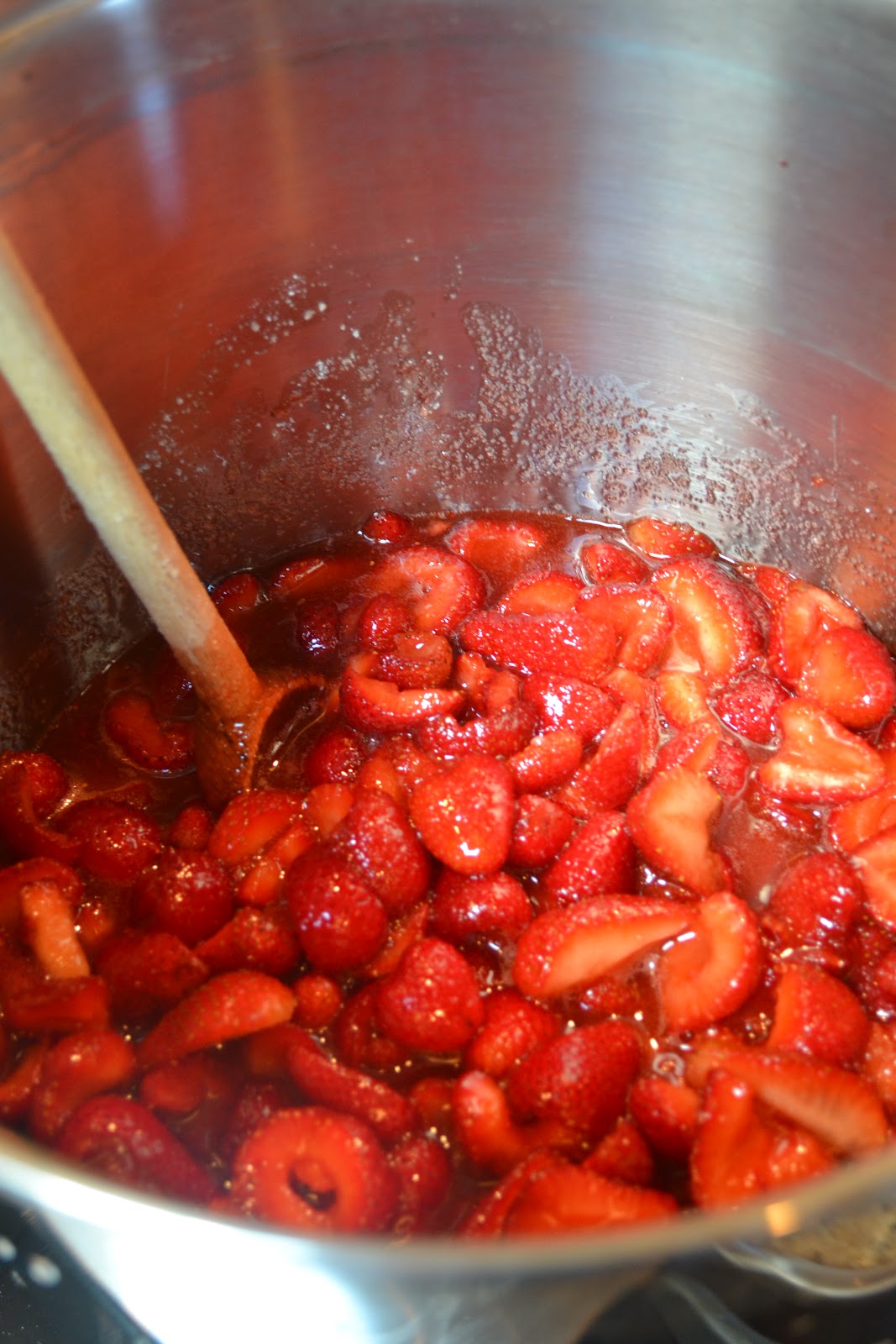
5. Turn up the heat to high and start stirring. It seems almost impossible in the beginning, but the heat quickly breaks the berries down and this gets so much easier.
6. Keep stirring and watching the soon to be jam carefully. Once it comes to a boil continue to cook it on high heat stirring regularly.
Watch out, this is when it really foams up. My jam foamed to nearly twice its size! This is why a huge pot is a must!
If the foaming gets out of hand, turn down the heat a bit and stir faster. Once I did this my jam went back down and it was more manageable and less terror inducing.

Meanwhile my jars and ladle were being sanitized and prepared for my tasty jam.
7. Once your jam has taken on a thick, syrup consistency, use an immersion blender to remove some of the larger chunks. You can also place 1/3 in a regular blender and then add it back into the pot. I accidentally overdid this part and my jam is basically completely smooth. Blend less than you think you need to. It’s hard to see how many chunks you really have under the thick liquid and the foam, so take it slowly.
8. Turn the heat back on and let it boil vigorously until it reaches 220 F (105 C). If you don’t have a candy thermometer (which I would highly recommend, it’s great for a lot of baking applications). You can tell it’s ready to be canned when the bubbles look thick and syrupy, and when you dip a spoon into the liquid it runs together and forms a a sheet (if instead it falls in drips singly and are very liquidy, it’s not ready and it needs to keep cooking).
9. Remove the pot from the heat, grab your ladle, and jam it into your jars. Be careful, your jam and your jars are super hot! Use towels to handle the jars (being careful not to touch the inside since it has been recently sanitized, and keep in mind that the jam will stain, so use rags or something red). Fill it almost to the top, leaving a 1/4 inch space at the top.
10. Wipe your jars completely clean around the top before placing your lids on or they will not seal properly.
11. Put on the lids and place the full jars back into the boiling water for 10 minutes.
12. Pull out your jars and let them cool on the counter. Be sure none of the jars are touching and that they are in a draft free place.
13. Be sure your jars have sealed properly by pushing down on the lids. If they are tight and have buckled in a little bit you have a proper seal. If your lids still pop when you push down on them, they did not seal and you need to store your jam in the fridge and consume within two weeks (or carefully freeze it).
If your lids set properly, store in a cool, dry place for up to a year.

One batch can easily last you up to a year (unless you are like me and practically drink the stuff). It is way cheaper than buying organic strawberry jam. It also makes great gifts (just be careful not to eat it all before Christmas). Mine will be divided up between my neighbors and my family.

Speaking of all of this jam, I think it’s time for some toast.

In the works

Sorry for the lack of posts lately, but I swear more are coming! I’m working on some delicious strawberry jam and strawberry sorbet to share with you soon. I’ve also started testing Pinterest “miracle” cleaners, and I can’t wait to share the results.

Wild: From Lost to Found on the Pacific Crest Trail Review

To put it simply, this book made me want to drop everything I was doing, grab some hiking boots and a much lighter pack than the one she carries, and get hiking. “Wild” is not a how-to guide for surviving the trail, but rather an interesting and thought provoking look at what pushed one woman, Cheryl Strayed, to hike for months on her own in the high mountains that follow the Pacific Coast.

Image courtesy of Marina Times
The book itself was a great reminder of the incredible beauty of the world around us. And even if I don’t drop of out of school and quit my job to go on a strenuous hike after reading this book, it will still encourage me to spend more time outside and remind me to push myself to do things I thought impossible.

Organic Food and the Influence of Big Corporations

Is your dedication to only buying organic food actually supporting large corporations? Do you really know all of the ingredients in your organic food? What does the label really mean and what are we all eating?


A recent New York Times article, “Has Organic Been Oversized,” delved into the business of organic foods and shed light on some of these questions. 

The fact is, organic food has become a wildly lucrative business for Big Food and a premium-price-means-premium-profit section of the grocery store. The industry’s image — contented cows grazing on the green hills of family-owned farms — is mostly pure fantasy. Or rather, pure marketing. Big Food, it turns out, has spawned what might be called Big Organic.
Bear Naked, Wholesome & Hearty, Kashi: all three and more actually belong to the cereals giant Kellogg. Naked Juice? That would be PepsiCo, of Pepsi and Fritos fame. And behind the pastoral-sounding Walnut Acres, Healthy Valley and Spectrum Organics is none other than Hain Celestial, once affiliated with Heinz, the grand old name in ketchup.
Over the last decade, since federal organic standards have come to the fore, giant agri-food corporations like these and others — Coca-Cola, Cargill, ConAgra, General Mills, Kraft and M&M Mars among them — have gobbled up most of the nation’s organic food industry. Pure, locally produced ingredients from small family farms? Not so much anymore.

For more food for thought, continue reading the article.

Cut the junk

One of the most annoying things is spam email and junk mail. I can’t stand the constant influx of spam email from things I have never signed up for and sometimes even heard of. While procrastinating today I emptied my spam box, but instead of hitting delete all like I usually do, I went through and unsubscribed to each one.

I felt so good after clearing it all out that I realized it was time to do the same for our mailbox at home. Most days there is no actual real mail, just a bunch of catalogs and other junk that we take straight from the mailbox to the recycling bin. On average, people receive 41 pounds of unwanted or “junk” mail every year, and 44 percent of that goes unopened (http://www.41pounds.org/impact/).

Image courtesy of Better Paper

On the back of every catalog is a number to call if you no longer wish to receive it. If you already have an online account with the company there is often a box online that you can uncheck to stop receiving their mailings.

It may take a few phone calls, but I am tired of having all the clutter and junk, not to mention the enormous amount of waste.

For tips and steps on how to get started, go to Better Paper.

Fourth of July aftermath

As I drove to work this morning the ground was covered in fine layers of ash and large chunks of debris. Entire streets looked as if parades had come through and left trash everywhere while others were so covered in soot the white lines on the street were a dark grey that nearly blended into the street.


Even though the scene appears to be the remnants of a massive fire, in reality it is what my neighborhood looks like after the Fourth of July. My city is one of two in the area that allow “safe and sane” fireworks. What this really means is that people waste hundreds of dollars to light chemicals and plastics on fire for hours on end. Many people invest in illegal fireworks that shoot into the air and explode for the entire valley to see. 


During the peak of the night I was dragged out of the house for a short walk around the block. The air was so thick with burning smoke that I could barely see the parked cars that lined the streets. My throat and eyes burned with every inhalation, and my ears rang with every explosion. I found myself wanting to crawl under my bed and hide like my cat was.


At work this morning a few of us were talking about how loud and damaging the fireworks in our cities were. The discussion went from the environmental harm and the difficulty we had sleeping the night before to all of the waste. Such a waste of materials. Of money. What if we gave all of the money our cities spend on firework shows to schools instead? What if people didn’t waste their money on a lights worth of pyrotechnics, but instead donated resources to their local schools or a fund that would help to build a community space like a park? 


How do we move past the idea that we need to explode things and cause complete havoc to celebrate a momentous occasion? 

How to ease sore muscles naturally

I recently started CrossFit again since coming back from school, and the transition has been brutal. I’m no stranger to sore muscles after nine years of competitive basketball, swimming, and all of the other activities I’ve fallen in love with. But over the years I have accumulated quite a few tricks to prevent sore muscles or help ease them if it’s too late.

Image courtesy of Sparkpeople.com

How to ease sore muscles naturally

1. Hydrate! Be sure to stay hydrated before, throughout your workout, afterwards. When I really pound back water after a workout I feel a noticeable difference in soreness than when I don’t. Coconut water is another great way to rehydrate. Throughout the day try to drink half an ounce of water per pound of bodyweight (meaning if you are 200 lbs you should drink 100 ounces). For more intense workouts, some trainers recommend drinking 3/4 ounces for every pound.

2. Warm up. Before you start working out, be sure to warm up your body gently. After you workout, keep your body warm to prevent muscles from tensing. A heating pad (you can make you own by pouring rice inside of a sock and heating it in the microwave) can also help to relieve tight muscles.

3. Stretch. Be sure to gently stretch your muscles. There are a lot of great poses or movements for specific muscles online. Just search the muscle group or area you want to stretch and carefully try a few out.

4. Magnesium. Found in many sports drinks, coconut water, and other foods, magnesium helps to release muscle tension. Calcium and magnesium work together to help your muscles move. Calcium makes the muscles contract, and magnesium makes them release. When I am really sore or my muscles feel incredibly tense I take a supplement. Just be careful, magnesium is one of the main ingredients in laxatives and it is easy to overdo it or throw off your bodies balance. Start with the smallest dose possible before finding your optimal level.

5. Rub it out. Self- massage can be a great way to release muscle soreness and tension.

6. Roll it out. My foam roller is my best friend. I foam roll before and after workouts as well as before bed. Foam rolling is essentially like massage in that it presses on the muscles and helps to release knots and tension. I also roll my calves on a 3 inch diameter PVC pipe. My trainer recommended this while I was battling shin splints, and it makes a huge difference.

7. Rest. Listen to your body. When you are sore your body is telling you it’s time to take a break and let it rebuild.

Healthier Version of Banana Bread

I hate really ripe bananas, but I love banana bread. To spice up this recipe I added some ground up flaxseeds and whole wheat flour. It was delicious, and you couldn’t even taste the healthiness.

Healthy Banana Bread Ingredients:

3 or 4 ripe bananas, smashed
1/3 cup melted butter
1 cup sugar (can be reduced to 3/4 of a cup)
1 egg, beaten
1 teaspoon vanilla
1 teaspoon baking soda
pinch of salt
1 and 1/4 cup whole wheat flour
1/4 cup ground flaxseed

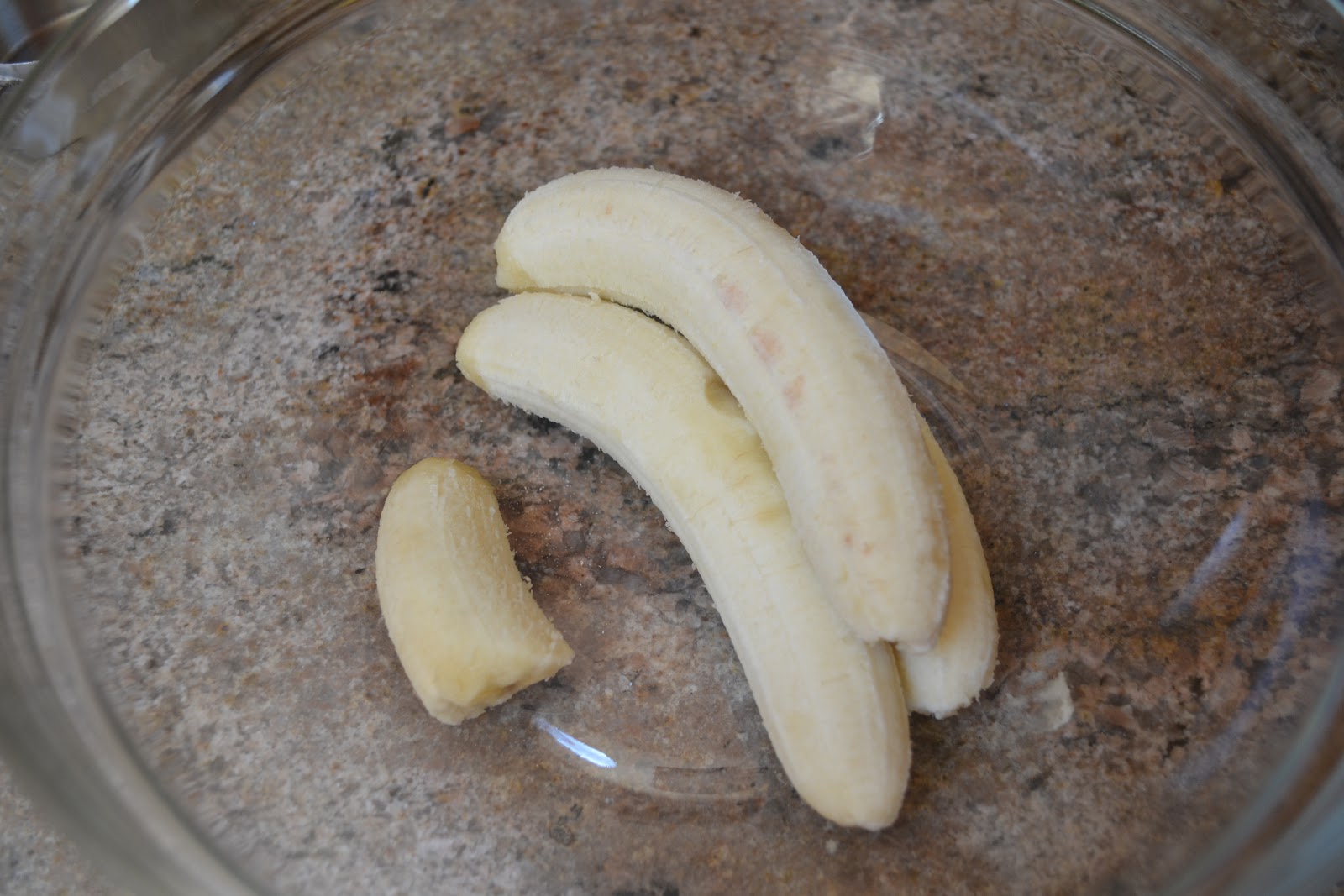
Healthy Banana Bread fair trade ripe bananas

Recipe:

1. Preheat the oven to 350 F
2. With a spoon (or a potato masher) smash the bananas and mix in the butter in a large bowl
Healthy Banana BreadHealthy Banana Bread mashed bananas<Healthy Banana Bread mashed bananas
3. Add in the sugar, egg, and vanilla
4. Add the baking soda and salt
5. Finally add the flour, and mix as little as possible to keep your bread tender


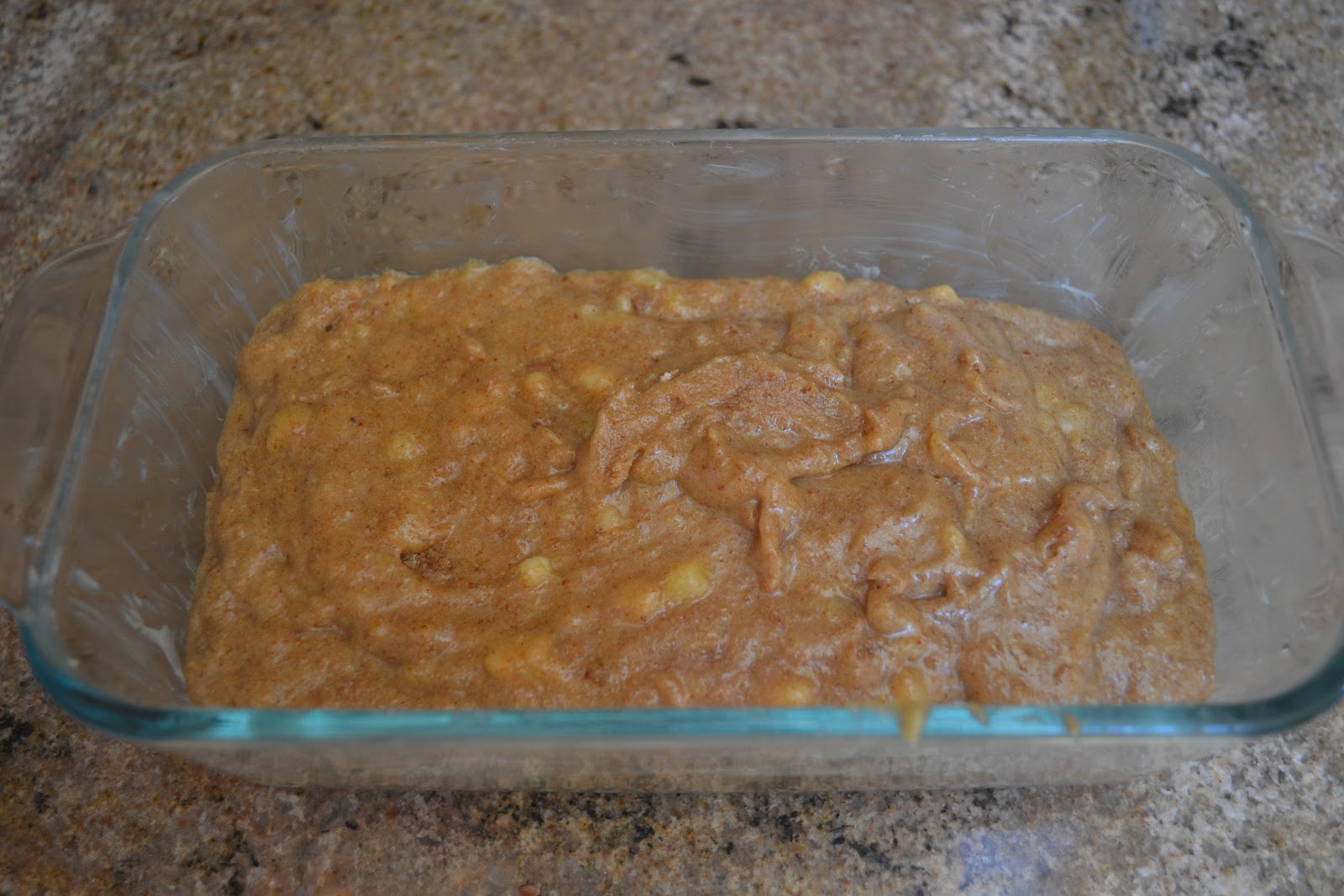
6. pour the batter into a buttered 4×8 inch loaf pan


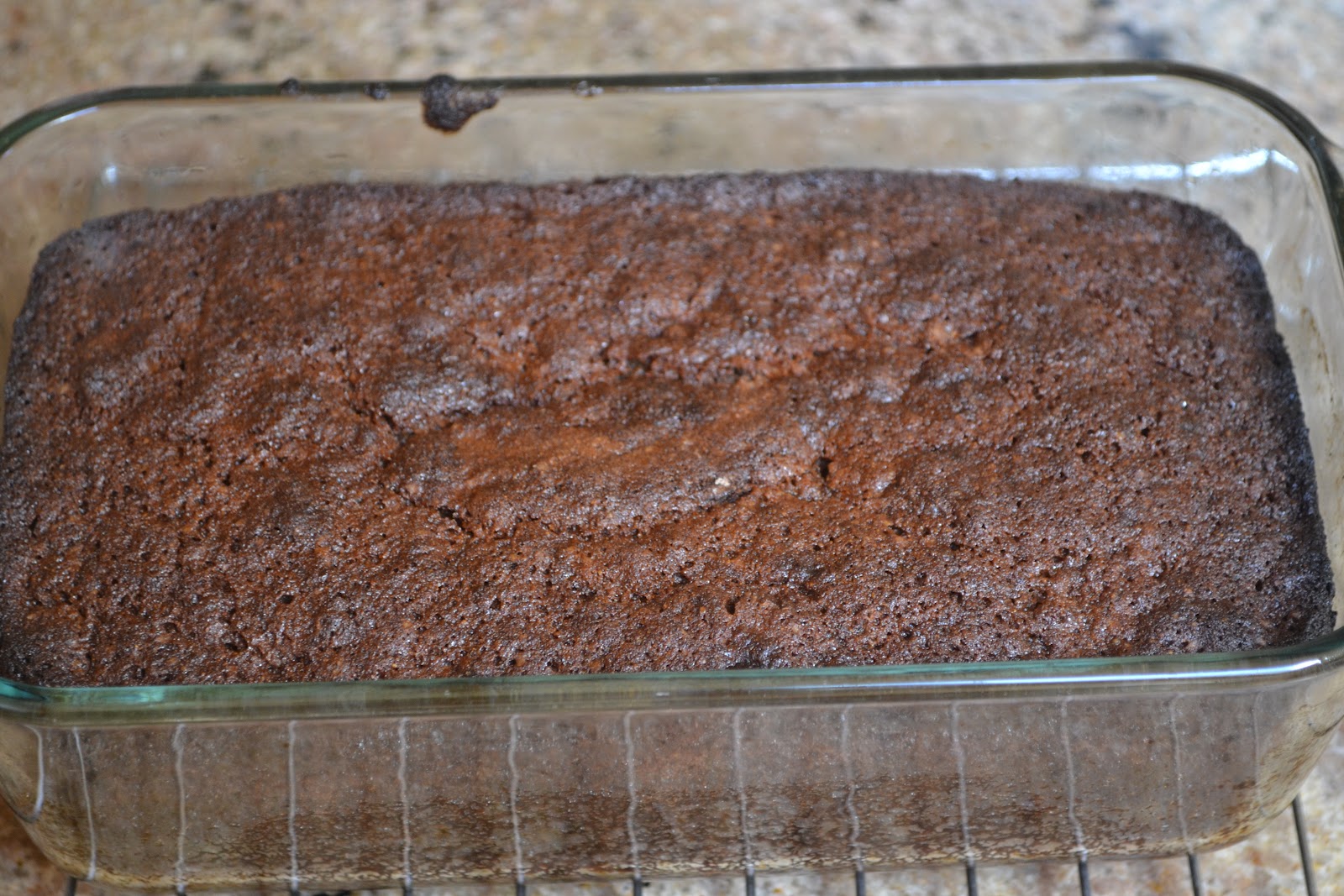
7. Bake for 1 hour
8. Cool on a rack before removing from the pan and slicing to serve
Healthy Banana Bread